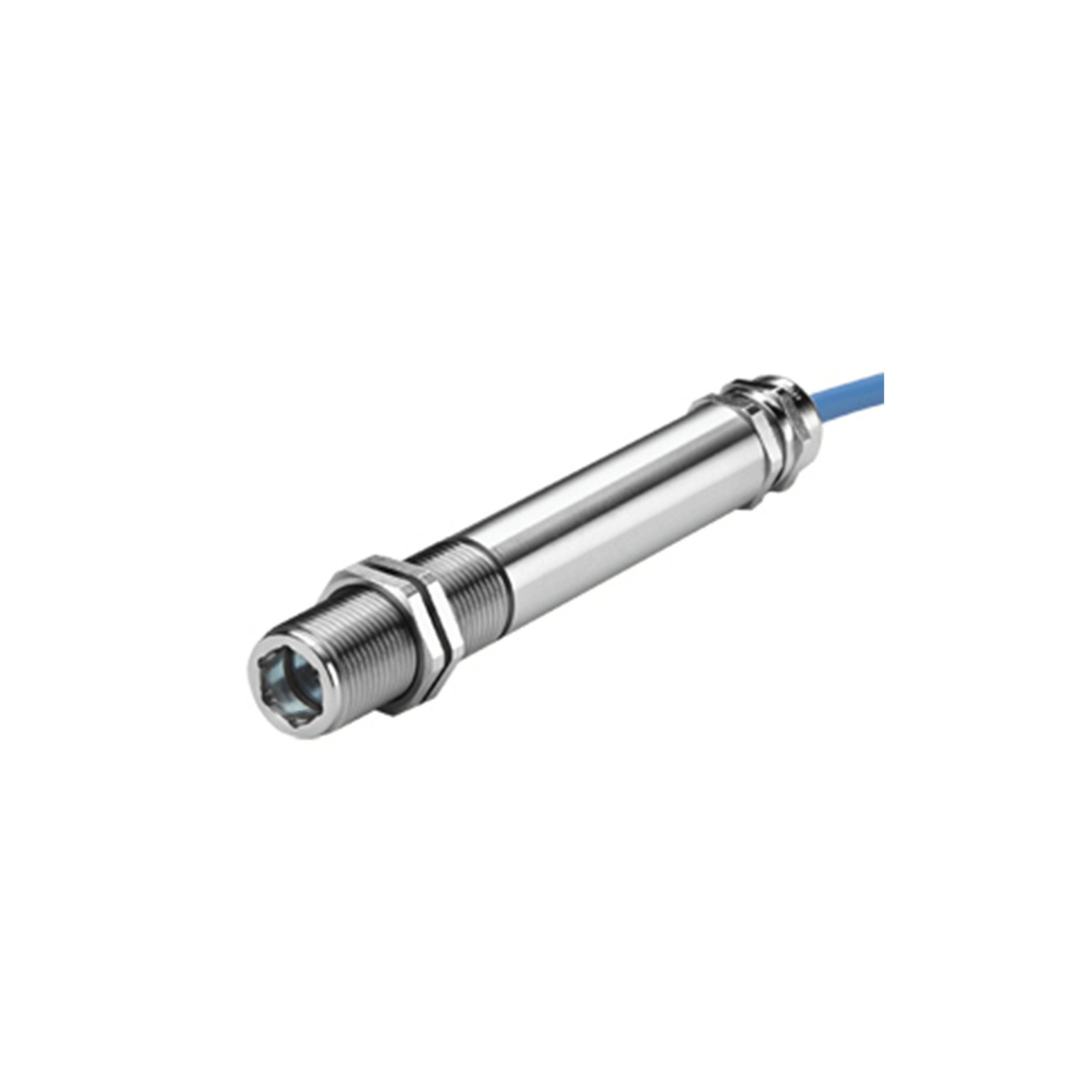
Infrared Temperature Sensor
Features:
✅ Intrinsically safe for use in Hazardous Areas: Zone 0, 1, 2 (Gas); Zone 20, 21, 22 (Dust) – with suitable isolator
✅ Non-contact infrared measurement with 4–20 mA two-wire output
✅ Temperature ranges up to –20 °C to 1000 °C (depending on FOV and variant)
✅ Adjustable emissivity from 0.20 to 1.00 (preset 0.95), configurable via USB adaptor
✅ Fast t₉₀ response time of 240 ms and high readout stability
✅ Compact 316 stainless steel housing, IP65 sealed, suitable for offshore environments
The OSAT Series from Omega Engineering is a compact, rugged, and intrinsically safe infrared temperature sensor designed for hazardous industrial environments. It offers non-contact temperature monitoring with high accuracy and fast response times, while ensuring full compliance with ATEX and IECEx standards.
The OSAT is an infrared pyrometer that is inherently safe. It has a direct 4–20 mA output and can measure the temperature of surfaces in dangerous regions without coming into touch with them. It has ATEX, IECEx, and TIIS certifications. The OSAT is a low-cost, tiny, and portable solution for measuring temperature in dangerous areas. In contrast to explosion-proof pyrometers, which usually have large, costly housings, it employs intrinsic safety as its protection mechanism.
Non-Contact Temperature Measurement with Precision and Speed
Infrared temperature sensors offer accurate, real-time temperature readings without direct contact, making them ideal for applications where conventional sensors cannot be used.
Key Features:
Non-Contact Measurement
Detect surface temperature from a distance using infrared radiation – ideal for moving objects or surfaces that are hard to reach.High Accuracy & Fast Response Time
Quick and precise measurements with response times as fast as 50 ms.Wide Temperature Range
Capable of measuring extreme temperatures, typically from -40°C to +1000°C (model-dependent).Adjustable Emissivity
Supports different surface types with configurable emissivity for better accuracy.Multiple Output Options
Available with analog (4–20 mA, 0–10 V) or digital (RS232, RS485, Modbus) outputs for seamless system integration.Rugged and Compact Design
Built for harsh industrial environments, with IP65/IP67-rated housings.Easy Installation
Compact size, mounting brackets, and optional laser sighting simplify alignment and setup.
Technical Data
TSW400 Thermowell
🔹 Technical Specifications – TSW400
â–¾
Design Standard ASME PTC 19.3 TW-2010 compliant Construction Solid-drilled, one-piece from bar stock Profiles Available Straight, Tapered, Stepped Process Connections Flanged, Threaded (screw-in), Welded (socket-weld / butt-weld) Tip Thickness Standard: 6 mm (customizable) Instrument Connection ½", ¾", 1" NPT, G-thread, or custom Immersion Length (U) Customized as per requirement Stem Diameter Typical: 12 mm to 25 mm (based on profile and application) Bore Diameter Standard: 6.5 mm, 8.5 mm, or customized to sensor size Velocity Collar Optional, for resonance suppression Surface Finish 1.6 µm Ra (standard), smoother finish optional Materials Available 316L, 316Ti, 321 SS, Hastelloy C-276, Inconel 600, Monel 400, Duplex, etc. Pressure Rating Up to ANSI 2500 / PN 400 (dependent on flange and material) Temperature Range Up to 1100 °C (material-dependent) Testing & Inspection Hydrostatic, radiographic, dye-penetrant, ultrasonic (as ordered) Material Certification EN 10204 3.1 standard; PMI optional Documentation Datasheet, welding certs, dimensional drawing, QC reports
Application
- Petrochemical: Monitoring bearing, gearbox, motor housing temperatures in refineries and chemical plants
- Storage tanks & reactors: Surface temperature measurement in Zone 0 environments
- Paper & pulp: Web temperature monitoring where dust could ignite
- Coal conveyors: Bulk material temperature screening with fast response
- Gas cylinder filling: Group IIC, T4 classification supports propane, hydrogen, acetylene
- Automotive painting and solvent operations
- Offshore platforms: Sea surface temperature monitoring and general rig surface readings